

Digital maturity is not just about adopting more and more of the latest technology. For organisations, it has to return some kind of business value or performance – improving efficiency, productivity, revenue or profitability for instance.
But digital maturity should also do something else. It should create longer-term sustainability.
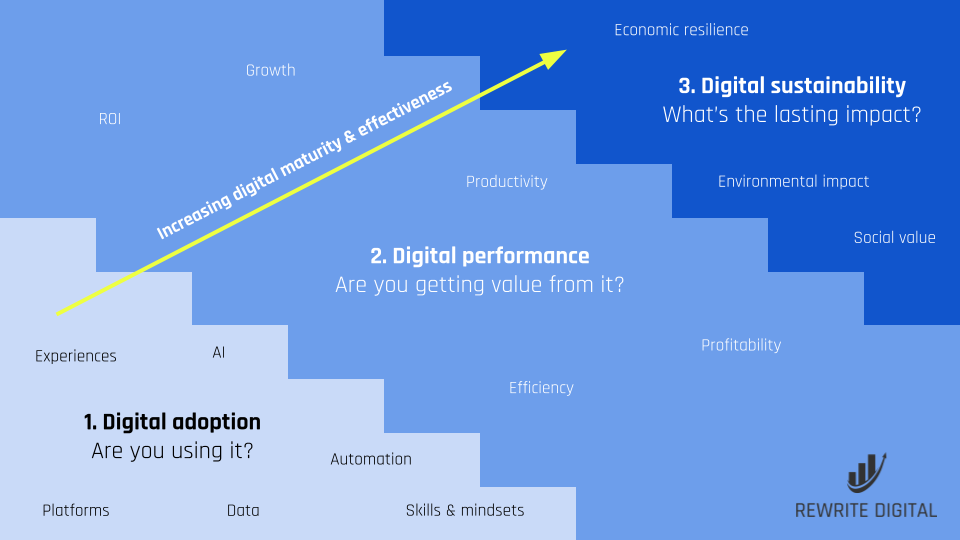
We frame digital maturity in three stages. These aren’t necessarily the steps an organisation completes and moves on from. They’re three different lenses of digital maturity and we need all three to be truly effective.
Stage 1 – Digital adoption
Digital covers all use of hardware and software – from internal systems to audience experiences, the data you collect and process automation, as well as the skills and mindsets of your people.
This first stage is all about how much digital is being used by an organisation.
We’ve always championed greater adoption of technology, and not just for the sake of it or to chase the latest shiny fads. It has to deliver results. More profitability, more growth, more efficiency.
This isn’t a given though and it can feel like digital adoption is often at odds with performance.
Countless IT projects and digital transformation programmes have failed to deliver on their promise or incurred spiralling costs. Businesses can think technology buys will solve problems but don’t always consider enough about how systems and data should be integrated or the skills and mindsets of their people.
Adoption is just the starting point.
Stage 2 – Digital performance
Is digital use increasing profitability? Improving productivity? Growing revenue? Reducing costs? Improving customer or employee experiences?
Take automation for example. There are huge opportunities to automate repetitive, manual processes, reduce administration and free up people’s time to focus on higher-value work. But simply automating an inefficient process doesn’t necessarily make it a good process. You might just be doing the wrong thing faster.
You may reduce the cost of handling customer enquiries with a chatbot. But if customers can’t get the answers they need, or still end up having to call someone, have you really improved performance?
Similarly, collecting more data doesn’t automatically mean making better decisions. You need the right data, integrated properly, interpreted effectively and actually used to inform decisions.
So it’s critical that digital maturity reflects both adoption AND performance.
But is that enough and what is the true cost?
Stage 3 – Digital sustainability
Look at AI. Is using more AI necessarily a sign of greater digital maturity? It may help you deliver a short term gain. But what about the compute costs, the reliance on third party US platforms, the environmental impact and the people impact on jobs and skills?
AI use has become a mainstay of our personal and professional lives but we should think about the wider and longer term impact and make better choices in how we use it.
Do you actually need AI to do some simple tasks? Do you need the latest, most powerful models? Could a simpler, cheaper and less resource-intensive solution achieve the same result?
Sometimes profit can seem to be at odds with people and planet. But it doesn’t have to be. The right choices on technology use can benefit commercially as well as environmentally and socially.
Better use of data can help organisations understand energy consumption, identify waste and make more efficient use of buildings and facilities.
Smarter forecasting can reduce overproduction, unnecessary stock and wasted resources. Online tools and meetings can reduce unnecessary travel.
You can make a positive impact environmentally and socially while still delivering business performance. In fact it’s critical to long-term resilience.
Take digital inclusion. Increasing digital adoption, without the right considerations can mean some people are left behind. Digital effectiveness should mean everyone comes with you so we always ensure that accessibility, training and support are built into digital programmes. Again, this isn’t just social responsibility, there’s a solid business case. It widens your audience and enables more of them to engage with you digitally.
From the energy demands, costs and people changes with AI to the opportunities for greater automation and personalisation, digital adoption can create both positive and negative impacts. The challenge is understanding these trade-offs, recognising where business and sustainability objectives reinforce one another, and making better-informed choices.
Digital maturity is not just whether technology is being used, but that it delivers short-term business performance and long-term economic, environmental and social value.
